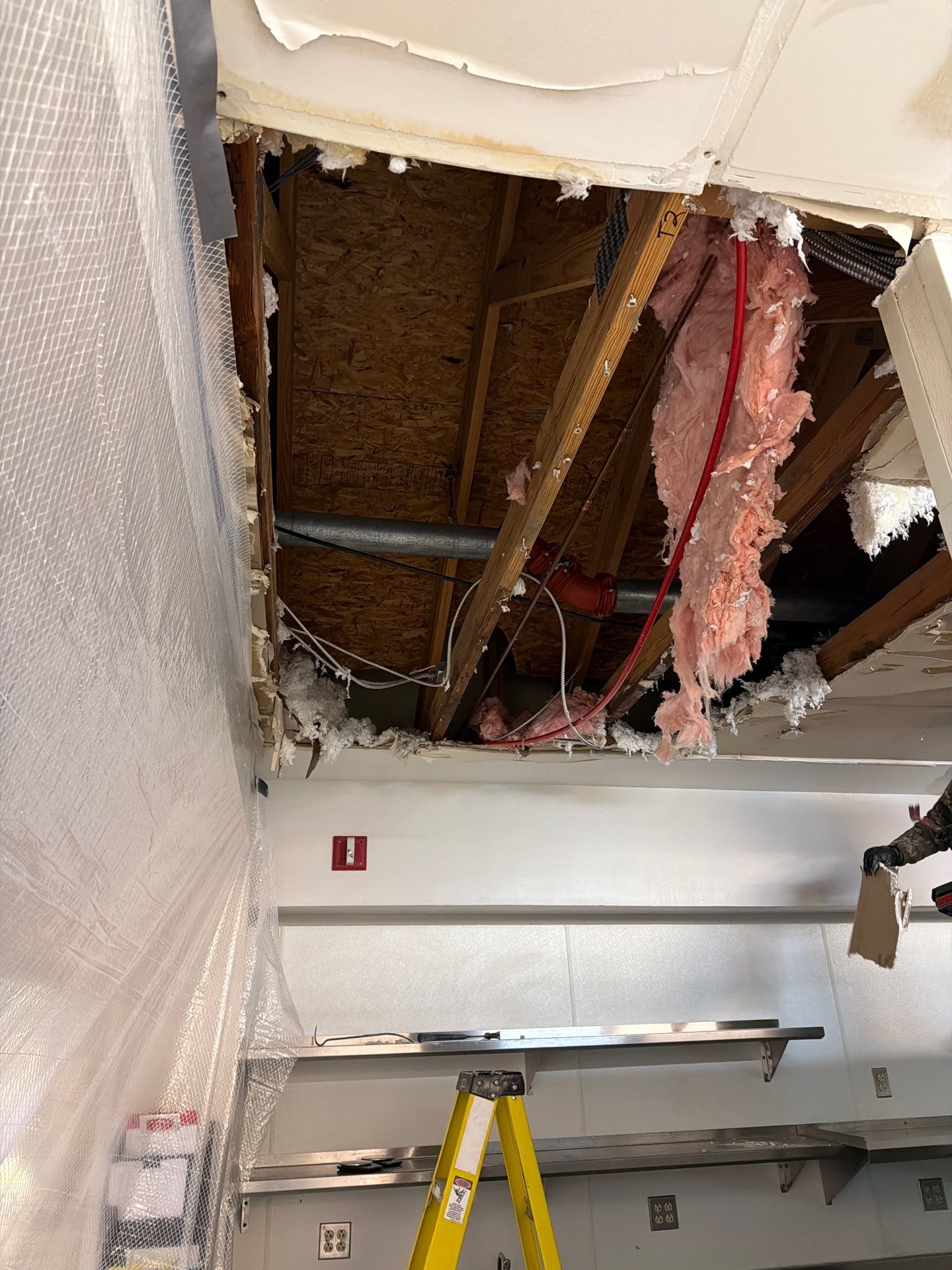
Why Attic Leaks Behave Differently Than Other Water Damage
Attic water damage operates on a slower clock than a burst supply line or a flooded basement. A pinhole in the roof deck might release only a cup of water per storm, but over a winter of freeze-thaw cycles that adds up to gallons soaked into batt insulation, fiberboard sheathing, and the top plates of your wall framing. The space is also poorly ventilated in most Upland houses, which means moisture lingers instead of evaporating. By the time the ceiling below shows a stain, you are usually dealing with three problems stacked on top of each other: saturated insulation, microbial growth on wood surfaces, and compromised drywall at the ceiling plane.
The other complication is category. Rainwater starts as Category 1 (clean), but the moment it filters through asphalt shingles, felt paper, dust, rodent droppings, and decades of attic debris, it shifts toward Category 2 or even Category 3. We treat almost every aged roof leak as at minimum a grey water event, which changes the cleaning protocol significantly. If you want the deeper breakdown of why that matters, our explanation of water damage categories walks through the science. The category determination drives whether insulation can be dried in place or has to be bagged out and replaced.
There is also a discovery gap that makes attic leaks uniquely expensive. Homeowners rarely climb into the attic except to swap holiday storage, so the first warning sign is almost always a downstairs symptom: a faint coffee-colored ring on the bedroom ceiling, a musty draft when the HVAC kicks on, or paint that suddenly will not hold to the crown molding. By that point, water has already traveled along the top of a joist, pooled at the nearest low spot, and wicked into multiple framing members. Upland Water Restoration sees this pattern weekly in Upland, and it is the main reason we push for attic inspections after any significant weather event rather than waiting for visible interior damage.
Comparing the Three Damage Scenarios We See Most Often
When we inspect a Upland attic, the situation almost always falls into one of three buckets. Each bucket has a different timeline, a different price band, and a different long-term risk profile. The table below is the framework we use to set expectations on site.
| Factor | Recent Small Leak (under 72 hours) | Chronic Slow Leak (weeks to months) | Major Storm Breach (active flooding) |
|---|---|---|---|
| Typical Cause | Wind-lifted shingle, popped nail, fresh flashing gap | Aged boot around vent stack, valley wear, ice dam residue | Tree impact, hail puncture, missing section after a storm |
| Water Category | Category 1 turning toward 2 | Category 2, often with active mold | Category 2 with debris contamination |
| Insulation Status | Localized wet spot, often salvageable if fiberglass | Compressed, matted, biologically active, replace | Soaked across wide area, replace entire affected bay |
| Sheathing Condition | Surface moisture, dries with airflow | Delamination, dark staining, soft spots | Possible structural compromise, engineer review |
| Mold Risk | Low if dried within 48 hours | High, visible colonies on rafters likely | Moderate, depends on exposure window |
| Ceiling Drywall Below | Stained, often salvageable | Sagging or cracked, usually replaced | Collapsed or imminent, replaced |
| Typical Restoration Range | $800 to $2,500 | $3,500 to $9,000 | $6,000 to $20,000+ |
| Drying Timeline | 2 to 4 days | 5 to 8 days plus remediation | 7 to 14 days plus structural repair |
| Insurance Outlook | Usually covered if sudden | Often disputed as maintenance | Covered under storm peril |
What the Comparison Tells You About Your Next Move
The single most important takeaway from that table is the cliff between column one and column two. A leak caught inside 72 hours costs a fraction of one that has been quietly running for months, because everything past 48 hours starts pulling mold remediation into the project. That is not a marketing line, it is the timeline backed by the IICRC and confirmed in our own field data. If you have noticed any ceiling staining, smell anything earthy near the attic hatch, or recently had a storm pass through Upland, the inspection itself is free and the math almost always favors looking sooner. Upland Water Restoration dispatches an assessment crew within 2 hours of your call in most cases, which is usually faster than the next available roofer can climb the ladder.
The second insight is about insurance. Sudden, accidental damage from a storm is the cleanest claim path. Chronic seepage from a roof the carrier considers neglected is the hardest. Documentation matters enormously here, and our crews photograph everything during the assessment so you have evidence regardless of which way the adjuster leans. Adjusters in Upland tend to look for three things specifically: a clear point of entry, moisture readings that match the reported timeline, and a separation between what the storm caused and what wear caused. We build the file with all three in mind, because a thin claim is the difference between full coverage and a denial letter. If you are unsure how to begin that paperwork, the walkthrough on filing a water damage insurance claim covers the exact sequence we recommend.
The third insight is structural. Sheathing and rafters are not drywall. You cannot just open windows and hope for the best, because the wood needs to come back below 16 percent moisture content before insulation goes back in, or you bury a mold farm inside your roof assembly. We use penetrating meters, thermal imaging, and dehumidifiers sized for the cubic footage of the attic, which is rarely what a homeowner can rent locally. The relationship between attic moisture and microbial growth is also why our team coordinates with our S520 protocols, similar to the approach outlined in our guide on mold after water damage.
Finally, the comparison shows you that timing is leverage. Every day a wet attic sits is a day insulation R-value drops, framing weakens, and remediation scope grows. A leak that would have cost $1,500 in week one routinely turns into a $7,000 project by month three, not because labor rates changed, but because the scope of materials needing replacement quietly tripled while no one was looking. Acting on suspicion is almost always cheaper than acting on certainty.